
Master Data for TMS: The strategic challenge behind Logistics transformation
Today, the conversation around digital transformation is dominated by artificial intelligence, predictive algorithms, and Industry 4.0 platforms—in other words, the latest technological trends.
However, there is a critical factor for the success of logistics transformation projects that does not always receive the attention it deserves: Master Data management.
The lack of a solid data architecture, governance framework, and disciplined management significantly reduces the likelihood of success in logistics transformation initiatives.
Software Needs Support: Why ERP and TMS Require High-Quality Data
ERP, WMS, and TMS systems are essential for managing organizations and enabling competitive advantage. Across multiple projects, empirical evidence consistently shows that the success of these systems is directly linked to an organization’s ability to structure and govern its data effectively.
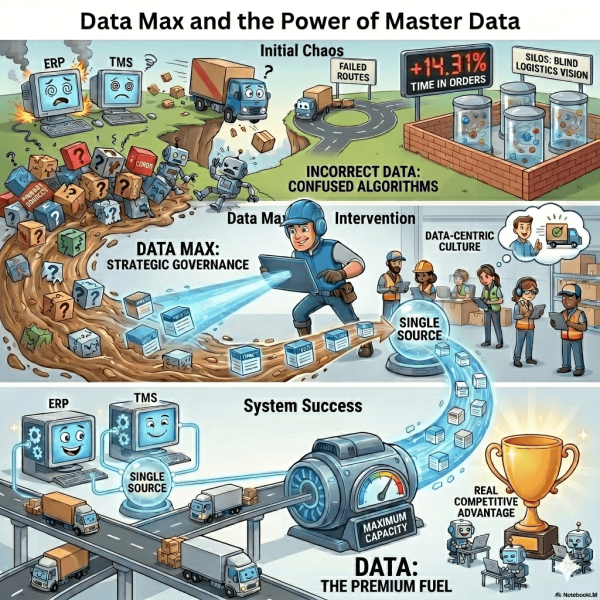
Master data should serve as the single source of truth, including information on products, customers, suppliers, and more. If this data is inconsistent, the algorithms relying on it will inevitably produce inaccurate results.

There Is a Real Cost Associated with Poor Data Quality
Academic research (Božić et al., 2024) demonstrates that master data quality has a direct impact on an organization’s logistics performance. While many organizations perceive this as an IT issue, the reality is that it affects overall financial performance:
- Processing Inefficiency: Order processing times can increase by up to 14.31% due to errors in product master data.
- Operational Friction: Additional costs arise from manual rework caused by inconsistent addresses, incorrect weight parameters, or duplicated units of measure—ultimately reducing net margins.
- Information Silos: Disconnected data across systems prevents a holistic view of the supply chain.
From Technical Data Management to Strategic Data Governance
Organizations must shift from viewing data as a technical concern to treating it as a strategic asset that drives competitive advantage.
To achieve this, organizations need to adopt a Data Governance and Master Data Stewardship model (Semarchy, 2025), built on the following pillars:
- Structured Governance: Clearly defined roles and responsibilities (Data Owners and Data Stewards) to ensure data integrity from creation onward.
- Interoperability by Design: Architectures that enable shared data consumption, eliminating silos between systems.
- Data-Centric Culture: Raising awareness among operational teams about the impact of poor data entry—ranging from delayed orders to potential customer loss.
The Reality
We are in the era of artificial intelligence and advanced analytics. However, these technologies are only as accurate as the data used to feed them.
A simple analogy illustrates this:
Technology is the engine of a vehicle, while master data is the fuel. If the fuel quality is poor, the engine will underperform—regardless of how advanced it is.
Are organizations assessing their level of maturity in master data management? Have they analyzed the impact of master data on the implementation of new information systems? Are organizations aware of the current state of their master data?



Start the digitisation of your supply chain with the help of our team of accredited professionals and advisors, who will be with you from the selection and evaluation of solutions, to implementation, technology administration and assistance.
