
The TMS every large enterprise will have
For years, a Transportation Management System (TMS) has had a relatively clear mission: plan loads, optimize routes, select carriers, manage rates, financials and track shipments. Every solution has added more functionality, more modules, and different levels of customization to fit each company’s transport operations, but the objective of every TMS has always pointed in the same direction: managing transportation.
But technology is also transforming TMS solutions, at the same time the transportation industry is seeing its room to maneuver shrink. Cost pressure, driver shortages, demand volatility, the need for real-time visibility, sustainability, and above all the arrival of artificial intelligence are reshaping what we expect from a TMS.
By 2030, the reference TMS will no longer be simply a system for managing transportation. It will be a platform connected across the entire supply chain, capable of understanding what is happening, anticipating problems, recommending alternatives, and increasingly, making decisions autonomously.
The TMS will shift from being a transactional system to becoming one of the primary decision engines of the supply chain.
A fully integrated, fully connected TMS
The first major shift will be connectivity.
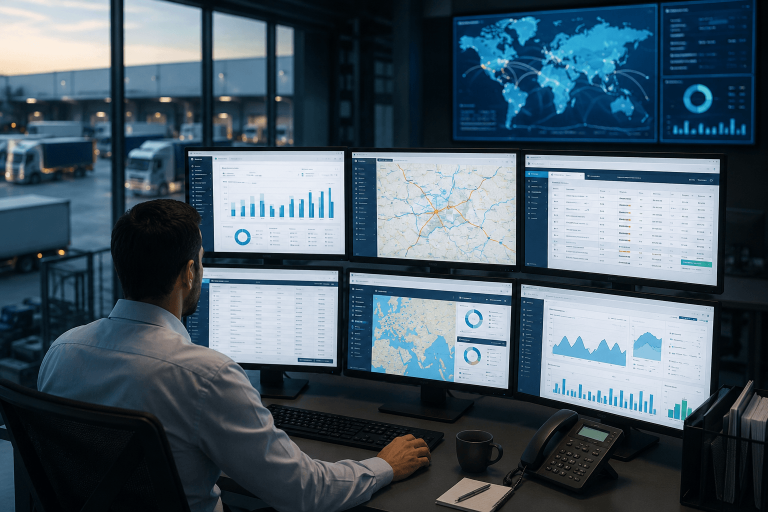
The 2030 TMS will be integrated end-to-end with the rest of the company’s technology ecosystem: ERP, WMS, planning systems, data lakes, integration platforms, financial systems, customer and supplier tools, and logistics execution solutions.
But integration won’t stop at internal systems. The TMS will also be connected to carriers, logistics providers, customers, suppliers, last-mile platforms, infrastructure, and telematics devices.
The goal will be to eliminate information silos and achieve something far more important: a single source of truth for everything happening across transportation.
Information will no longer travel between disconnected systems, arriving too late to the people who need to make decisions. It will be available, contextualized, and real-time, right when a user needs it.
Connected telematics, for everything
By 2030, tracking a shipment will mean much more than knowing where a truck was the last time the driver logged an event on the platform. Telematics will be deeply integrated with the TMS, feeding operational data directly into planning and execution processes.
Speed, real-time GPS, harsh driving events, unplanned stops, tachograph data, driver fatigue, engine temperature, cargo temperature, door openings, and geofence entries and exits will all be available variables.
It will even be possible to incorporate driver risk profiles, using scoring models and behavioral analytics.
Onboard cameras will also play a significant role. Beyond improving safety, they will provide evidence in the event of an accident, claim, or liability dispute.
And the driver will no longer be a disconnected element within the system.
Cab login will let the TMS know exactly who is performing the service, their availability, their driving hours, and whether they meet every requirement needed to start the shift.
Telematics will not be a bolt-on application. It will be a data source built into the TMS’s decision-making — and not only for owned or dedicated fleets. Carriers’ customers will increasingly require third-party fleets to capture and share certain data, such as real-time GPS location.
The objective is clear: it isn’t just that companies will need more control and visibility. This information will be shared, to some extent, across carriers, shippers, and consignees awaiting the goods.
The TMS will also manage driver availability
One of the biggest challenges in transportation will remain the same in 2030 — likely even more acute: professional drivers.
That’s why the TMS of the future can’t limit itself to managing vehicles and loads. It will also need to account, days in advance, for the availability and status of the driver workforce.
Shifts, time off, working and driving hours, licenses, permits, certifications, medical fitness checks, documentation, and expiration dates will all be connected to transportation planning as an internal workforce management module.
Before assigning a trip, the system will be able to verify whether the driver is genuinely available, on-site at the facility, and cleared to carry it out.
The result will be a far more advanced concept of planning: not simply scheduling a vehicle, but confirming that every required resource is actually available to execute the shipment. Drivers may well become a bottleneck going forward — until autonomous trucks arrive — and it’s a variable that transportation management will need to keep front and center.
Fleet management, fully integrated
Fleet maintenance will follow the same path. Optimization will already be complex enough without a vehicle going out of service due to poor planning.
Telematics data will make it possible to anticipate maintenance needs and know, in real time, which vehicles are available, which are in maintenance, and which are operating under restrictions.
This will connect planning, execution, and proactive maintenance during lower-demand windows.
If a vehicle becomes unavailable, the system will be able to automatically identify which loads are affected and search the network for alternatives.
The line between fleet management and transportation management will keep blurring. The TMS will look for the precise moments when a given vehicle should go in for maintenance, aiming not to disrupt transport demand at that moment — and ensuring that early signs of a maintenance need are never left unaddressed.
A truly connected transportation network
Another major shift will be the evolution from a single-company TMS to a multi-enterprise network. Carriers, logistics providers, shippers, suppliers, and other service providers will all be connected within the same ecosystem.
That doesn’t necessarily mean everyone runs the same software.
It means they will be able to interoperate seamlessly, sharing the information needed and working from a shared view of the operation.
This will enable a shift away from fragmented communication — emails, phone calls, portals, and multiple disconnected systems — toward a network where the different parties can exchange information in real time.
The result will be a more accurate, transparent, and collaborative network. And above all, a network where decisions are made against the same operational reality.
From TMS to Supply Chain Command Center
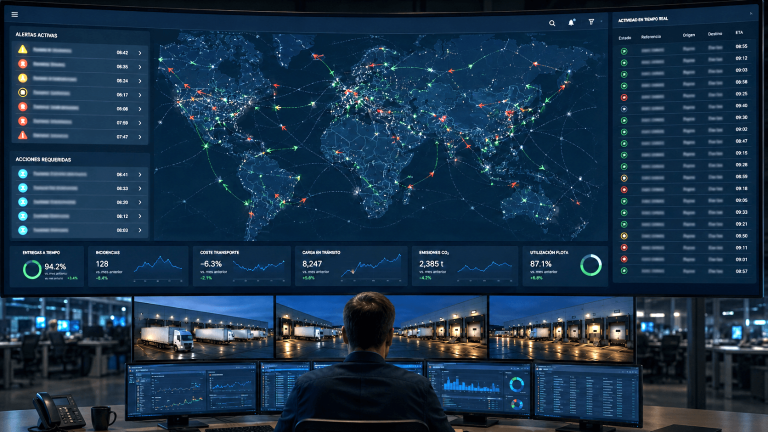
Perhaps one of the most visible changes will be the evolution of today’s Control Towers. By 2030, a Control Tower shouldn’t be limited to showing a map with trucks in motion.
It will need to answer far more relevant questions:
- What is happening?
- What could happen?
- What impact will this have on my supply chain?
- What can I do to prevent it?
Imagine a critical shipment is going to arrive six hours late. The system won’t just fire off an alert. The solution will be able to identify which order is tied to that shipment, which customer is waiting on it, what stock exists at other warehouses, what other transportation is available, what it would cost, and what alternatives exist to avoid a supply disruption. No more mobilizing multiple people across different sites or countries — the system, by drawing on data from different connected tools, will simply deliver the best recommendation to resolve the issue.
The Control Tower will thus become a true Supply Chain Command Center.
A layer where different systems and information sources converge to deliver a unified view of what actually matters.
AI moves from informing to acting
Artificial intelligence will likely be the single most important shift. But the value of AI in the TMS won’t simply lie in adding a chatbot or auto-generating reports. The real transformation will come from AI understanding operational context and actively participating in decision-making.
For example: a supplier’s shipment arrives a day late at a port. As a result, it misses its sailing with the carrier, causing a total delay of three days. That delay triggers a production stop at Plant 1. But partial stock exists in a warehouse in another country to cover production for the next three days. A transport option is available that would allow for an urgent transfer. The additional cost would be X euros.
The system won’t just explain what’s happening. It will be able to recommend a course of action and justify why. And in certain scenarios, it will even be able to execute the decision directly, following the rules and objectives the company has defined.
A TMS that learns from the operation
Intelligence will also allow the system to move beyond working exclusively with static rules. These systems will be able to analyze large volumes of historical and operational data to identify patterns:
- Which carriers are most likely to run late on specific routes?
- Which types of loads see the most incidents, and which priority shipments — based on destination or characteristics — are best handled by a specific carrier?
- Which routes actually generate the most cost, and in which cases does it pay off more to use one carrier over another based on periodically negotiated rates?
- Which combination of carrier, vehicle, and schedule produces the best results?
- What driver behavior or professional conduct is associated with certain delays?
- What have been the most recurring or most significant incidents, and, in a similar scenario, what needs to happen to prevent them?
- Which past decisions have delivered the best outcomes?
The TMS will use this knowledge to continuously improve its decisions.
Optimization will stop being purely mathematical and start incorporating context, operational experience, and prediction.
Cloud-native, SaaS, and continuous evolution
All of this requires a different technology architecture.
The 2030 TMS will be cloud-native and SaaS, with continuous capability evolution and automatic updates. Companies won’t have to wait years to upgrade their platform or run major upgrade projects.
New features, performance improvements, analytics capabilities, and AI innovations will roll out continuously — often no more than an hour of downtime, scheduled during low-activity windows.
To make that possible, the architecture will be open and interoperable. A next-generation TMS can’t aim to be the company’s only system. It has to be able to connect with the existing technology ecosystem — and whatever comes next.
From managing transportation to unified decision-making
All of these shifts point in the same direction. The 2030 TMS won’t be a collection of independent modules for managing transportation. It will be a platform where the following converge:
- Transportation Management
- Telematics and IoT
- Fleet Management
- Workforce Management
- Carrier Management
- Control Tower
- Analytics
- Artificial Intelligence
- ERP, WMS, and corporate systems
- A network of partners, carriers, customers, and suppliers
The key will be ensuring all of these elements operate on a single operational reality:
- One single source of information.
- Real-time visibility.
- A connected network.
- Coordinated decisions.
The 2030 TMS is already being built
2030 may seem far off, but many of these capabilities are already showing up in next-generation TMS platforms today.
The TMS of the future won’t just be the system that decides which truck should carry which load. It will be the system that understands the state of the transportation network, knows the constraints on its resources, identifies risks, anticipates their consequences, and helps decide what to do next. And the more connected the company, the greater the value of that capability.
That’s why the question companies should be asking isn’t simply “Do we need a TMS?” The question should be:
Is our TMS ready to become the transportation decision-making system, connected across our entire supply chain?
At BlueGistics, we are already rolling out this new generation of Tier-1 TMS, built precisely on these principles: cloud, interoperability, artificial intelligence, connected networks, and unified decision-making.
Because the TMS of 2030 won’t simply be a tool for managing transportation. It will be a foundational piece of managing the supply chain.

Start the digitisation of your supply chain with the help of our team of accredited solution architects and consultants, who will be supporting your TMS project with implementations, global roll-outs, migrations and upgrades, quick-wins, extended support and trainings.
